The Lord of the Rings (1978 Film) Review
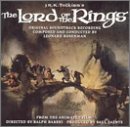
Assuming that most purchasers of this product (any of the Rosenman "Lord of the Rings" products") will be more familiar with Howard Shore's epic soundtracks to "The Lord of the Rings" films of Peter Jackson (2001, '02, 03), a comparison and contrast to Roseman's score for Ralph Bakshi's animated--but certainly not cartoonish--"Lord of the Rings" (1978) is apt.
Shore's score is a behemoth. It features an epic breadth of instrumentation and motifs derived successfully, though not particularly innovatively--from a range of sources, including so-called "Celtic." Shore employs Tolkien's inventive languages, too, very skillfully. Alas, Rosenman essentially steers completely clear of them. Shore's work is well-established at the time of this review (2009); a live production of it is now on tour, and a few years ago its signature segment, "The Ring Goes South," was played at half-time during the American Super Bowl. Shore's great soundtrack fits the unprecedentedly grand and involved project of Peter Jackson.
Compared to Shore's score, Rosenman's is less developed, more repetitive, more strictly programmatic, and less grand. That does not mean it is not extremely enjoyable, which I believe it is. Compared to Shore's, Rosenman's score is more intimate and sustains itself in a higher key. Rosenman is unafraid to use a piano and a harpsichord, and manages to use them effectively. The recording (AAD) is very crisp, with every section of the orchestra cleanly heard; given its pre-digital era birth, it is not surprising that the recording is not over-produced with technicians' computer feats.
Given its more intimate quality, Shore's score is most successful when interpreting individual characters and precise moments, not the grandiloquence associated with the tale itself and the themes of life and death it deals with. While Shore "The Ring Goes South," is large-scale and grand--almost worthy of Wagner--and evokes adventure and myth, Rosenman's score's main theme evokes travel, the notion of journey, and the naturalistic way Tolkien renders this vital concept--perhaps the most consistently important concept in Tolkien's trilogy beyond the main one itself: that little things, including individuals literally or figuratively small, can make world-changing differences with courage, supportive friends, and determination to complete a noble cause.
Thus, I whistle. Rosenman's music has tightly-rendered tunes evoking steady momentum, and make me want to whistle. Shore's music carries the weight of the scope of an entire history; but, Rosenman's will conjure up Hobbits hiking along sun-bathed hills and dales, or traveling along an ancient road. As Tolkien wrote, "The road goes ever on / down from the door where it began." It is first clearly articulated about 5:45 into the opening segment, "History of the Ring," but is first properly heard about 1:04 into the third segment, "The Journey Begins." In a sense, Rosenman's entire score is travel music punctuated by moments of danger ("Fleeing the Orcs"), sadness ("Mithrandir"), and battles ("Helm's Deep.") The notion of the unhappy, scary forced march is also present at times, and particularly about 1:00 into "Following the Orcs." Gollum's theme is the least innovative, with very predictable orchestration portraying a rather galumphing, basically comic character. Shore is far more successful evoking danger. The ominous choral drone of the word "Mordor" repeated creates a sense of Sauron's long-reaching evil influence. Also, in my opinion, Rosenman is nowhere else in the score more effective than when bringing to life the shrill, chilling sense of orcs and orcish battle horns. These moments are, to me, great depictions of an exotic terror, and though they are only occasional, I think they capture the essence of orcish menace more effectively than even Shore manages to do anywhere in his score.
"Mithrandir" is a solid segment featuring a choir, including children's voices, and may not be to everyone's taste insofar as it is grand in a staid sort of way, hymnic and anthem like, befitting a stereotypically sentimental song from The Last Night at the Proms, or perhaps a gathering of the Women's Institute (WI). In places, it is arguably a bit overwrought and comes close to maudlin, but fortunately never crosses that line into the likes of, say, "Danny Boy."
What is more, I happen to like The Last Night at the Proms, and given the vague quality of "Englishness" evoked for me by "Mithrandir," I suspect that the segment is as much a Rosenman tribute to Tolkien himself to as the character, Gandalf (who is called Mithrandir in one of Tolkien's elvish languages). Tolkien--already old by the time me became famous--is routinely associated with his old wizardly character, Gandalf, as the maker of events and giver of wisdom. Whether or not Rosenman had such a Tolkien tribute in mind, I don't know. But Tolkien's mythic vision was, without a doubt, a distinctly English and middle-class one, also influenced by his Roman Catholicism, which may makes the anthem-like qualities of "Mithrandir" all the more appropriate. I think that the pipe-smoking, woolen-waistcoat-wearing, Oxford literature lecturer, and temperamentally highly conservative creator of Middle-Earth would have greatly enjoyed Rosenman's "Mithrandir," and they may be a highest achievement of all in comparison to Shore's masterwork.
The Lord of the Rings (1978 Film) Overview
Japanese reissue & the worldwide CD debut of Leonard Rosenman's soundtrack to Ralph Bakshi's 1978 cinematic interpretation of J.R.R. Tolkien's epic fantasy. 15 tracks. 1997 Victor release.
*** Product Information and Prices Stored: Apr 21, 2010 08:10:08
star wars omnibus